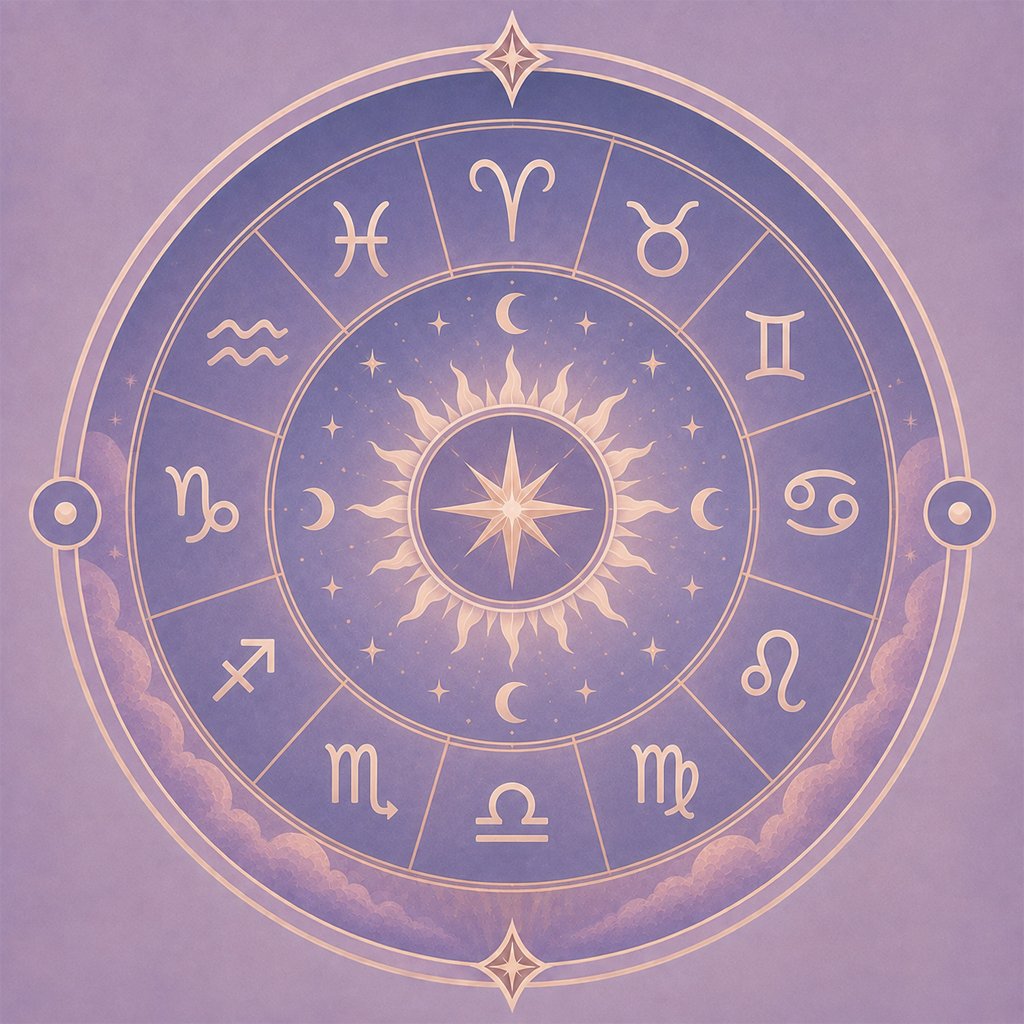
Your Star Map
Ten bodies, your ascendant, your midheaven and the full ring of houses — computed from the exact moment and place you arrived, and drawn as a wheel.
Your birth details stay in your browser. The chart is calculated on your device and nothing is sent to us or stored anywhere.
How this chart is calculated
Positions come from standard orbital theory, computed in your browser rather than looked up. They are precise well beyond what ordinary chart reading requires. House placements are a different matter: they depend on an accurate birth time, an accurate location, and on which house system is in use.
Houses use the Placidus system, the most common in Western astrology. Placidus is undefined above the polar circles, so charts from those latitudes fall back to equal houses and say so.
For work that needs arc-second precision — rectification, or timing to the minute — a professional ephemeris is the right tool. This chart is built for reading and reflection.
What The Wheel Shows
A star map is a diagram of the sky from one place at one instant. It records where each body sat along the zodiac, which of the twelve houses each fell into, and the angles they formed with one another.
Everything astrology has to say about an individual comes out of that single snapshot. There is nothing else in the method — no additional information, no ongoing observation, just the moment of arrival.
It is drawn as a wheel because the houses rotate. The chart is oriented to the horizon at birth, with the ascendant on the left and the midheaven at the top.
The Three Inputs
Date, time and place, and each does distinct work. The date establishes where the planets were, the place establishes the horizon, and the time establishes how far the wheel had turned.
Miss the time and nine of the ten planetary signs remain correct while the entire house layer becomes unusable. The Moon is the exception — it moves fast enough that half a day can change its sign.
Birth certificates commonly record the hour, and the office that issued yours can usually supply a copy. It is worth the effort: the house layer is most of what a chart adds to a sun sign.
The Big Three
Sun, Moon and ascendant carry most of what people recognise as a personality, and reading them together resolves most of the complaints that a sun sign does not fit.
The Sun is the direction somebody is oriented toward; the Moon is what they revert to in private; the ascendant is the manner they lead with before anybody knows them.
Two people sharing a Sun sign but differing in the other two are recognisably different people, which is the whole argument for calculating a chart rather than reading a horoscope column.
How This One Is Calculated
Positions come from standard orbital theory, computed in your browser rather than looked up. They are precise well beyond what ordinary chart reading requires.
Houses use the Placidus system, the most common in Western practice. Placidus is undefined above the polar circles, so charts from those latitudes fall back to equal houses and say so rather than failing silently.
Nothing you enter leaves the page. The wheel is drawn on your own device and no birth detail is transmitted to us or stored anywhere.
What It Cannot Tell You
A chart describes disposition, not outcome. It does not predict events, forecast relationships, or indicate how anybody's life will go.
It has no bearing on health, money or legal matters, and nothing produced here should be used in place of qualified advice on any of them.
Read as a description of temperament within a symbolic tradition, it is detailed and often striking. Read as a forecast, it is neither reliable nor what the tradition claims for itself.