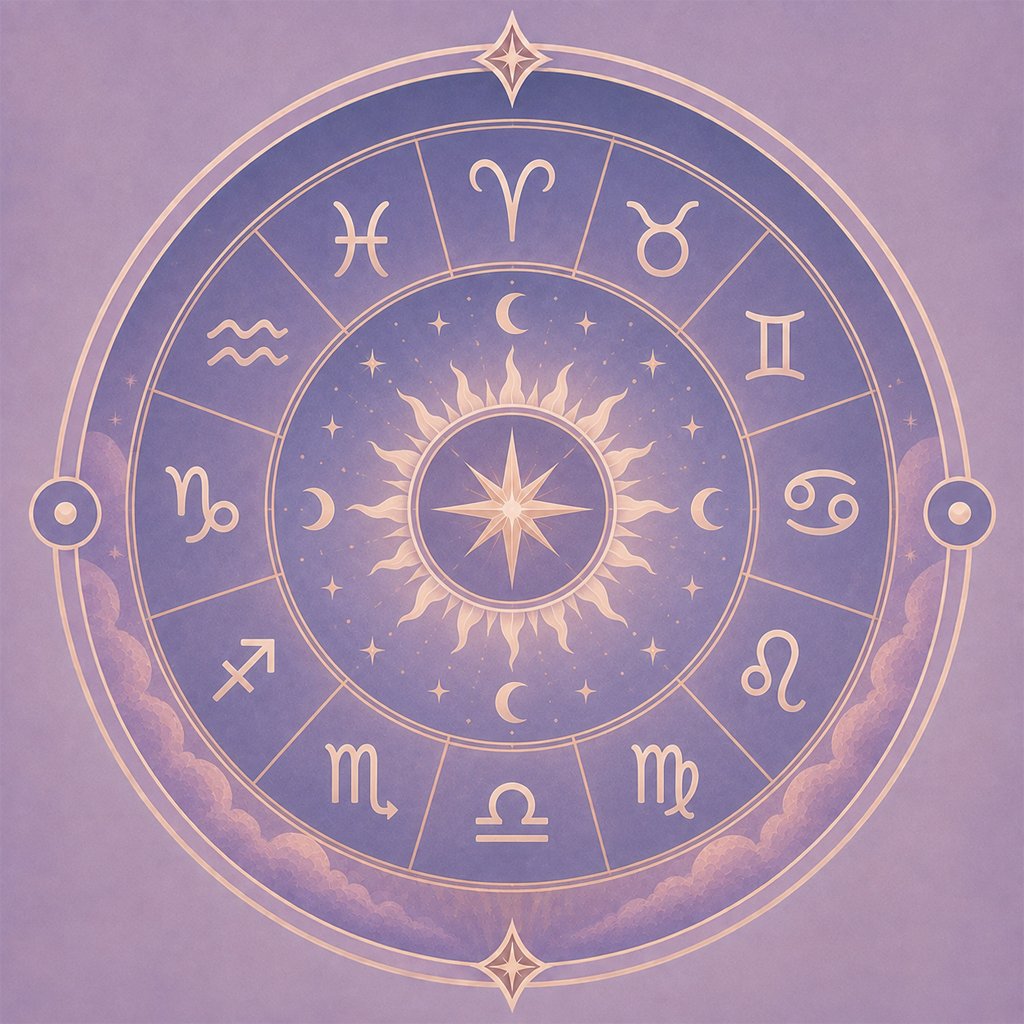
Your First Week With Astrology: What to Learn in What Order

The usual way people meet astrology is a horoscope column, which is the least useful part of it. The second way is opening a full chart, which is overwhelming.
There is a sensible order to learn this in, and it takes about a week of occasional attention rather than months of study.
Day one: the big three
Start with three placements and ignore everything else.
Your Sun sign you already know. It describes the direction you are oriented toward — what you are recognised by and what a life well spent looks like to you.
Your Moon sign describes the private layer: instinct, emotional habit, and the conditions you need before you can settle. Find it with our Moon Sign Finder, which will also tell you whether your birth hour matters for your particular date.
Your rising sign describes how you present before anybody knows you. This one needs a birth time and there is no way around it, since it changes roughly every two hours.
Between them those three account for most of what gets recognised as a personality. If your sun sign has never fitted, one of the other two usually explains why.
Day two: the four elements
The easiest structural idea in the system, and the one that does the most work.
Fire acts, earth builds, air reasons, water feels. Every sign belongs to one, three signs to each element, and two signs sharing an element get on almost effortlessly.
Read the elements section and test the descriptions against people you know. It is immediately checkable in a way most astrology is not, which makes it a good place to build confidence.
Day three: count your own elements
Now apply it. Take your Sun, Moon and rising, and see which elements they fall in.
Most charts lean. Three placements in one element describe a default mode you reach for automatically. An element with nothing in it names a faculty that had to be built rather than inherited — and that gap is usually the more informative half.
Our Element Balance calculator does this with proper weighting and will take more placements as you find them.
Day four: the three modalities
Less intuitive than elements and it explains something elements cannot: why two signs of the same element behave so differently.
Cardinal signs open a season and initiate. Fixed signs sit in the middle and persist. Mutable signs close a season and adapt.
Taurus and Virgo are both earth; one holds and one refines, and the modality is the entire reason. The modalities section covers all three.
Day five: the ten planets
This is where a chart stops being a sun sign and starts describing an individual.
Each planet is a function rather than an object. Mercury is how you process information. Venus is what you value and how you show warmth. Mars is how you pursue things and handle obstruction. The sign describes the manner that function operates in.
Learn the five fast ones first — Sun, Moon, Mercury, Venus, Mars — since those differ between people born weeks apart. The slow planets describe cohorts and matter less individually. The planets section covers all ten.
Day six: the twelve houses
The last of the three layers, and the one that needs a birth time.
Where signs describe how and planets describe what, houses describe where — which department of life a function shows up in. Mars in the sixth applies drive to daily work; Mars in the ninth applies it to travel and belief.
Do not try to memorise all twelve. Learn the four angular ones — first, fourth, seventh, tenth — which are the loudest in any chart, and pick up the rest as they come. The houses section is there when you need it.
Day seven: read your own chart
Now open the whole thing. Our star map calculator draws the wheel and lists every placement.
Read it in this order: find the horizon line, locate your ascendant at its left-hand end, then read anticlockwise. Take the Sun, Moon and ascendant first. Then anything sitting close to an angle. Then your chart ruler — the planet ruling your rising sign — and note which house it landed in.
Say each placement as a sentence: planet, sign, house. “Venus in Capricorn in the second house.” What, how, where.
Ignore the lines across the middle entirely for now. Aspects are the next layer and they will still be there in a month.
What to do after that
Read three charts belonging to people you know well. That is where you find out whether you are reading the chart or your own expectations, and it is the single most useful exercise available.
Expect to be wrong sometimes. A chart that cannot be wrong is not telling you anything, and the parts that miss are usually pointing at a placement carrying more weight than you assumed.
And keep the limits in view: charts describe dispositions within a symbolic tradition. They predict nothing, diagnose nothing, and have no bearing on decisions about health, money or law.