How to Read a Birth Chart Wheel Without Getting Lost

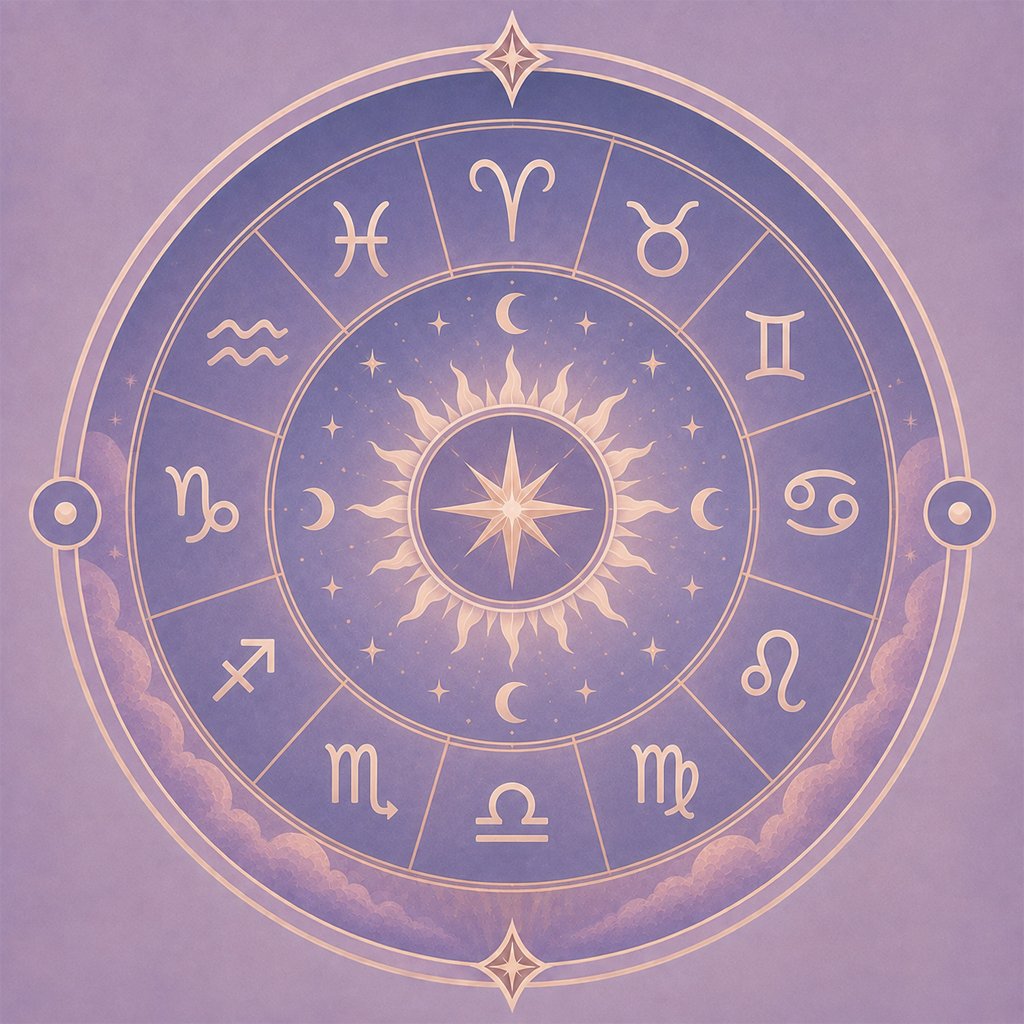
The first time somebody sees their own chart wheel, the usual reaction is that it looks like a circuit diagram. Twelve segments, ten glyphs scattered around them, coloured lines crossing the middle, numbers around the rim.
It resolves quickly once you know the order to read it in. The trick is not to start with the symbols.
Find the horizon first
Before reading anything else, locate the horizontal line running across the middle of the wheel. That is the horizon at the moment you were born.
Its left-hand end is the ascendant — the point rising on the eastern horizon, and the start of your first house. Its right-hand end is the descendant. Everything below the line was under the horizon when you were born; everything above it was in the sky.
The vertical axis is the second landmark. Its top is the midheaven, the highest point the chart reaches, and the start of your tenth house. Its bottom is the imum coeli, the base of the chart.
Those two lines divide the wheel into four quarters, and knowing which quarter a planet sits in already tells you something before you have identified a single glyph.
Read anticlockwise from the ascendant
The houses are numbered from the ascendant and run anticlockwise, which catches everybody out at first. House one starts at the left-hand horizon and runs downward; house two follows it; and so on around to house twelve, which sits immediately above the ascendant.
That direction is not arbitrary. It reflects the apparent daily motion of the sky, and once you have read a few charts it stops feeling backwards.
The three-layer question
Every placement in a chart answers three questions at once, and keeping them separate is the single most useful habit a beginner can build.
The planet is what. Which function is operating — Mercury for thinking and speech, Venus for what you value and how you show warmth, Mars for how you pursue things.
The sign is how. The manner that function operates in. Mars in Aries pursues directly; Mars in Pisces pursues indirectly and frequently more effectively than the directness of fire expects.
The house is where. The department of life it shows up in. Mars in the sixth applies drive to daily work; Mars in the ninth applies it to travel and belief.
Say them in that order — planet, sign, house — and any placement becomes a sentence rather than three symbols.
What to read first
Not everything on a chart carries equal weight, and reading it as a flat list is how people get overwhelmed.
Start with the Sun, Moon and ascendant. Between them they account for most of what gets recognised as a personality, and they explain most complaints that a sun sign does not fit.
Then look at anything on an angle — a planet sitting close to the ascendant, midheaven, descendant or imum coeli. Angular placements are the loudest in a chart and are usually the first thing a stranger could tell you about somebody.
Then the chart ruler: the planet ruling your ascendant sign. Traditional practice treats it as the most important body in the whole chart, and wherever it sits is where the life story tends to concentrate. A Virgo ascendant makes Mercury the chart ruler; if that Mercury is in the tenth house, the life organises itself around work and public standing.
Only after that is it worth working through the remaining placements one by one.
The lines across the middle
Those are aspects — the angular relationships between planets, and the layer that turns a list of placements into a description of a person.
Two planets close together are conjunct, and their functions operate as a unit for better or worse. Ninety degrees apart is a square, read as friction that produces movement. A hundred and twenty degrees is a trine, read as agreement that never needed negotiating. A hundred and eighty is an opposition, the two functions pulling against each other at the same tempo.
Beginners are usually better off ignoring aspects entirely for the first few charts. Get comfortable with planet-sign-house first; the lines will still be there afterwards.
Empty houses are normal
Ten bodies across twelve houses guarantees at least two empty in every chart ever drawn. Most charts have four or five, and people routinely read that as a blank in their life.
It is not. An empty house is read through the sign on its cusp and through wherever that sign’s ruler sits, which routes the department to another part of the chart. What an empty house indicates is that the department is not one of the chart’s headline themes — it is being handled, just not loudly.
Where the birth time bites
Everything above the level of planetary signs depends on an accurate birth time. The houses rotate through a complete circuit every twenty-four hours, so a four-minute error moves the cusps by a degree and an hour moves them by fifteen.
Without a time, the planetary signs remain reliable and the entire house layer, the ascendant and the midheaven become guesswork. Any reading offering house placements from a date alone is inventing them.
Our star map calculator collects date, time and place, draws the wheel, and lists every placement with its house. Where the hour is unavailable it says which parts of the reading are affected rather than filling them in silently.
Keep going
Chart reading is a skill that improves by repetition rather than by study. Read your own, then read the charts of three people you know well — the second group is where you find out whether you are reading the chart or your own expectations.
For the underlying material, the houses section of the almanac covers all twelve in turn, and the planets section does the same for the ten bodies.