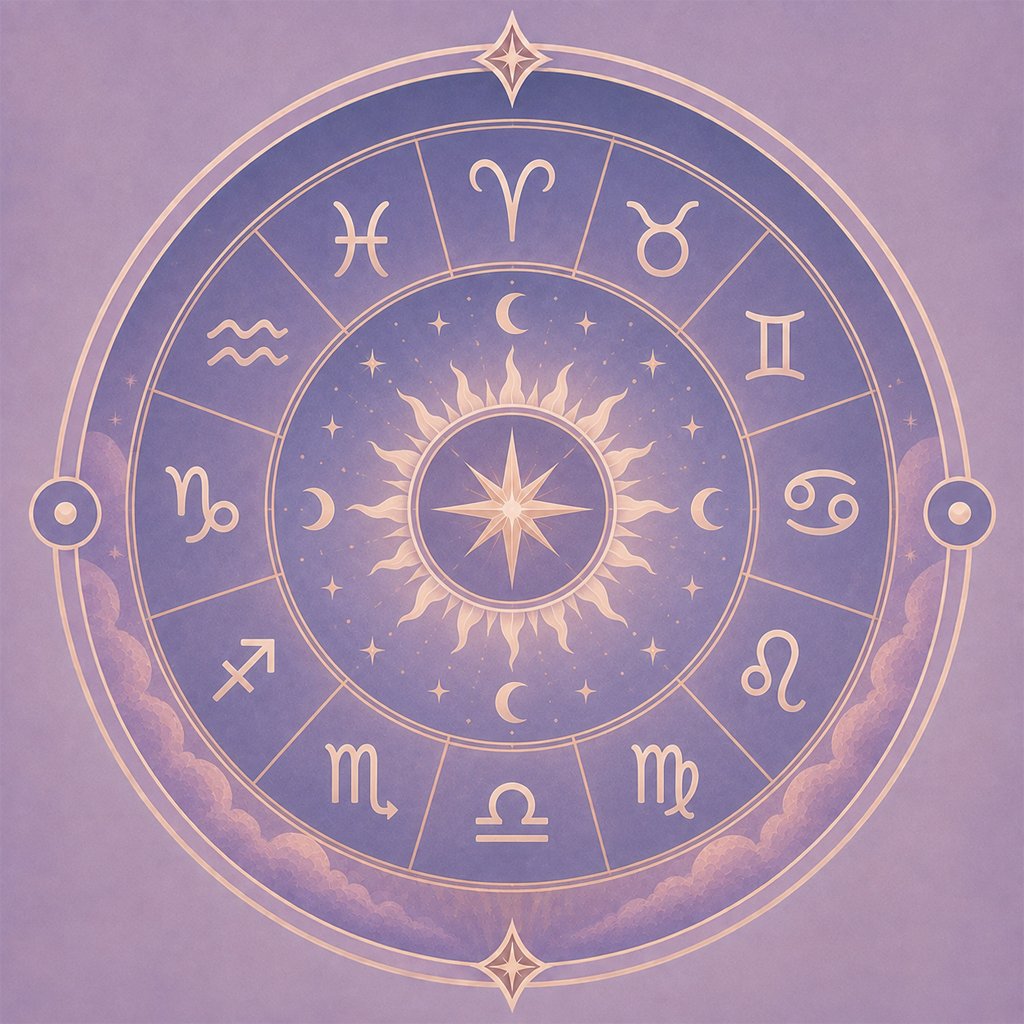
The Lunar Calendar: What Each Phase Traditionally Marks

The Moon is the one astronomical object everybody can see changing. Over roughly twenty-nine and a half days it runs from invisible to fully lit and back, and almost every culture that has ever existed built a calendar on it.
What follows is what the cycle is, what the tradition reads into it, and — equally important — what it demonstrably does not do.
The mechanism
The Moon produces no light of its own. Half of it is always lit by the Sun; what changes across the month is how much of that lit half faces us.
At new moon the Moon sits between Earth and Sun, so the lit side faces entirely away. At full moon the Earth sits between them and we see the whole lit face. The phases in between are the gradual transition.
Four of the eight named phases are exact astronomical moments defined by the angle between Sun, Earth and Moon: new, first quarter, full and last quarter. The other four — the crescents and gibbous phases — are the week-long stretches between them.
The waxing half: building
From new to full, the lit portion grows. The tradition reads this fortnight as accumulation, and the folk practices consistently put starting tasks here.
The new moon is read as an opening: intentions, beginnings, things set in motion before there is anything to show for them. The common practice is writing down what you are starting and reviewing it at the full moon, which as a fortnightly review habit is perfectly sensible whatever one makes of the framing.
The waxing crescent is the first visible sliver, read as an intention taking practical form. Small, early, not yet robust.
The first quarter shows half the disc lit and marks a quarter of the cycle — the name refers to the fraction of the cycle, not the fraction illuminated, which confuses people constantly. Sun and Moon are ninety degrees apart here, a square, and the tradition reads it as the point where an intention meets its first real obstacle. That maps onto something ordinary: most undertakings do hit friction about a week in.
The waxing gibbous is the refinement stretch. The shape of the thing is visible and what remains is correction before it comes to a head.
The waning half: releasing
The full moon is culmination: things reaching visibility, situations coming to a head. Because the Earth sits between Sun and Moon, a full moon always falls in the sign opposite the Sun — which is the structural reason the phase gets read as a tension surfacing.
The waning gibbous is sometimes called the disseminating phase, associated with sharing what the cycle produced rather than pursuing it further.
The last quarter is the point of honest assessment: what worked, what did not, and what should not be carried into the next cycle. Sun and Moon are square again, now closing rather than opening.
The waning crescent, sometimes called balsamic, is rest before the cycle restarts. The thinnest interpretive tradition of the eight, and the phase fewest people ever see — it rises just before dawn in a narrowing window.
Phase and sign are different
This confusion comes up constantly and is worth settling. The phase describes how lit the Moon is. The sign describes where it sits along the zodiac.
They run on separate clocks — the sign changes every two and a half days, the phase over twenty-nine and a half — and any phase can occur in any sign. A full moon in Scorpio and a full moon in Taurus are the same phase in different places.
Practitioners who work with the lunar calendar read both together, which is where the more specific interpretations come from. Your natal Moon sign uses the sign, not the phase.
Eclipses and supermoons
An eclipse is a phase that happens to occur when the Moon is also near one of the two points where its orbit crosses Earth’s. Solar eclipses happen at new moons, lunar eclipses at full moons, and both come in seasons roughly every six months.
A supermoon is a full moon near the closest point of its orbit. It is genuinely larger — by around seven per cent against average — which is a real difference and one almost nobody detects by eye.
Neither is astrologically special in any way the tradition can strongly support. They are ordinary phases with additional geometry.
What the phases do not do
No phase of the Moon affects health, sleep, mood, fertility or behaviour. The full-moon studies are among the most thoroughly conducted in this whole area — hospital admissions, crime rates, psychiatric presentations, births — and they consistently find nothing.
The tidal argument does not survive the numbers. Tides act on ocean basins; the effect on a body of water the size of a person is smaller than the effect of standing up.
What the cycle does supply is a shared calendar, which is a real and modest thing. Marking a month by something visible in the sky is useful. Expecting it to act on you is not.
Following the current phase
Our lunar calendar computes tonight’s phase from the actual position rather than estimating it, and covers each of the eight in turn. For the astronomical events that stack on top of the cycle — eclipse seasons, retrogrades, ingresses — the sky watch calendar tracks the year.