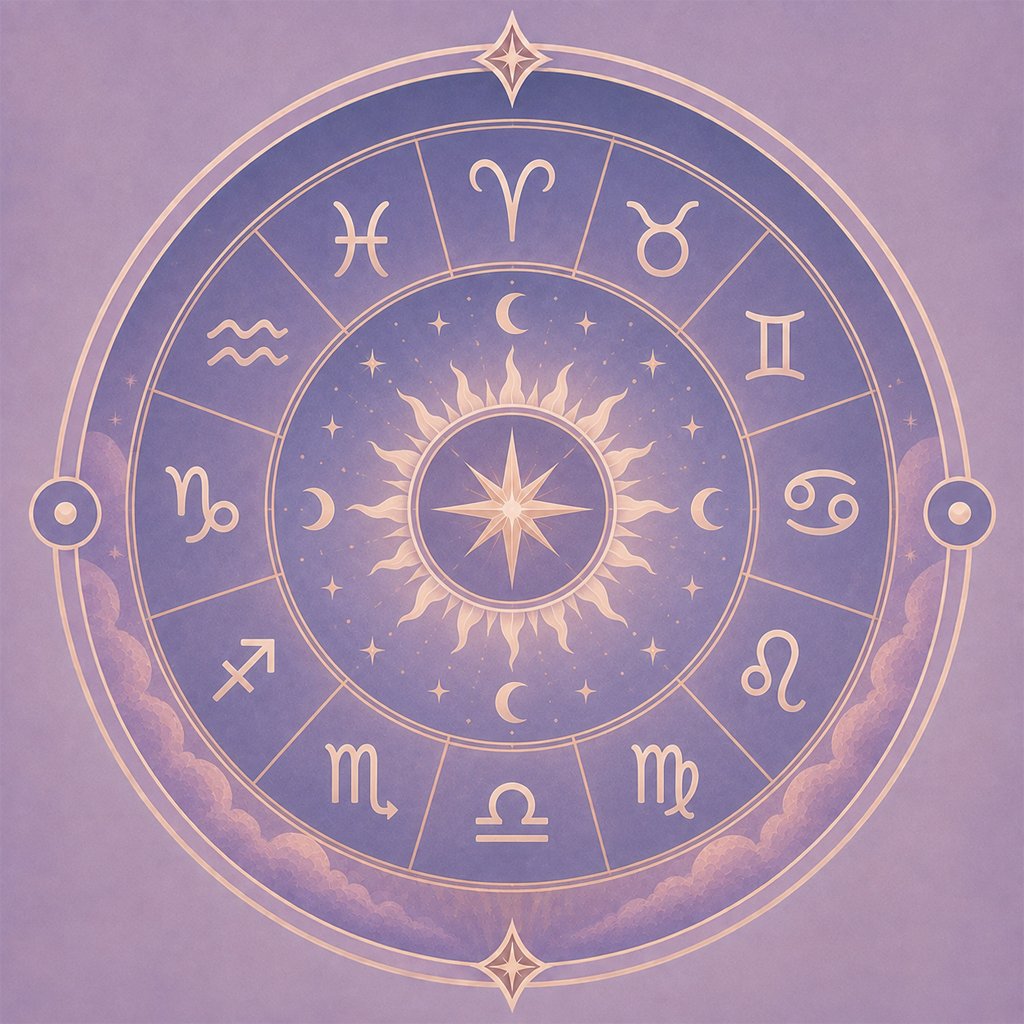
Born on the Cusp? Why Your Sign Is Not Actually a Blend

Somebody born on 22 August is told they are a Leo by one source and a Virgo by another, and concludes they must be both. It is one of the most persistent misunderstandings in popular astrology, and the reality is more interesting than the folk version.
The boundaries move
The Sun does not change sign on a fixed calendar date. It crosses each boundary at a specific moment, and that moment drifts.
A year is not a whole number of days. The Sun consequently arrives at each boundary about six hours later each year, then snaps back when February acquires its extra day. Across the four-year leap cycle, the crossing moment for any sign varies by nearly a full day.
That is why every printed date range is an approximation. “Leo: 23 July to 22 August” is true most years and wrong in some, and for anybody born within a day of either end, the printed table is simply not good enough.
What is genuinely true
If your birthday falls near a boundary, your sign depends on your birth year and sometimes your birth hour. That is a real uncertainty and worth resolving properly.
The resolution is computation rather than a table. Our Sun Sign Decoder calculates the Sun’s actual position for your date and year rather than reading from a printed range, which is why it occasionally disagrees with a magazine — and is right when it does.
What is not true
The idea that cusp births produce a blend of two signs — a Leo-Virgo, a Pisces-Aries — describes nothing astrological. At any given instant the Sun occupies exactly one sign. There is no overlap and no transitional zone.
Astrologers are unusually united on this. It is not a matter of interpretive disagreement; it follows from the definition of a thirty-degree segment.
Why the blend feeling is real anyway
Here is the part that makes the folk belief understandable. People born near a boundary very often do read as a mixture — and the reason is other planets, not the Sun.
Mercury never strays more than about twenty-eight degrees from the Sun, and Venus stays within roughly forty-eight. Both routinely cross into the next sign before the Sun does.
So somebody born in the last days of Leo may well have Mercury and Venus already in Virgo. That produces a person who genuinely thinks and values like a Virgo while their core orientation is Leo — an authentic mixture, arising from separate placements rather than from a Sun in two places at once.
Anybody who identifies strongly with a cusp label is usually describing exactly this, and a full chart will show it precisely.
The other explanation: your rising sign
The second common source of a blended feeling has nothing to do with cusps at all.
Your ascendant governs how you present and how people read you before they know you, and it changes roughly every two hours. Somebody with a Leo Sun and a Virgo ascendant reads as careful and precise to almost everyone, while the Leo orientation is entirely real and reserved for people who get past the manner.
That is not a cusp effect. It is two layers of a chart doing different jobs, and it accounts for a great many people who feel their sign only half fits.
What about the sidereal question
There is a third reason somebody might be told a different sign, and it is worth knowing about because it produces genuine confusion.
Western astrology uses the tropical zodiac, anchored to the March equinox. Vedic astrology uses the sidereal zodiac, anchored to the constellations. The Earth’s axis wobbles across a twenty-six-thousand-year cycle, so the two have drifted about twenty-four degrees apart.
A tropical Leo is frequently a sidereal Cancer. Neither system is in error — they measure from different reference points and each is internally consistent. Everything on this site uses the tropical zodiac, which is what almost all Western material means by a sign.
The thirteenth-sign story
Every few years a headline announces that astronomers have found a forgotten constellation and everybody’s sign has changed. The constellation is Ophiuchus, the Sun does pass across it, and none of this is remotely new.
The error is treating the zodiac as a map of constellations, which it has never been. The tropical zodiac divides the Sun’s path into twelve equal arcs measured from the equinox. The constellations scattered along that path vary wildly in size, straddle the divisions untidily, and never furnished the basis for the measurement.
A sign is thirty degrees of a circle, not a picture. Your sign has not changed, and the story returns because it makes an excellent headline.
Settling it for your own birthday
If you were born within a day or two of a boundary, enter your date and year into the Sun Sign Decoder. It computes the Sun’s real position and tells you plainly if your birthday falls close enough to the line that the hour matters too.
For the fuller answer — including which of your other planets landed on which side of the boundary — the star map gives you every placement at once. That is where a cusp birthday stops being a puzzle and becomes a rather detailed description.